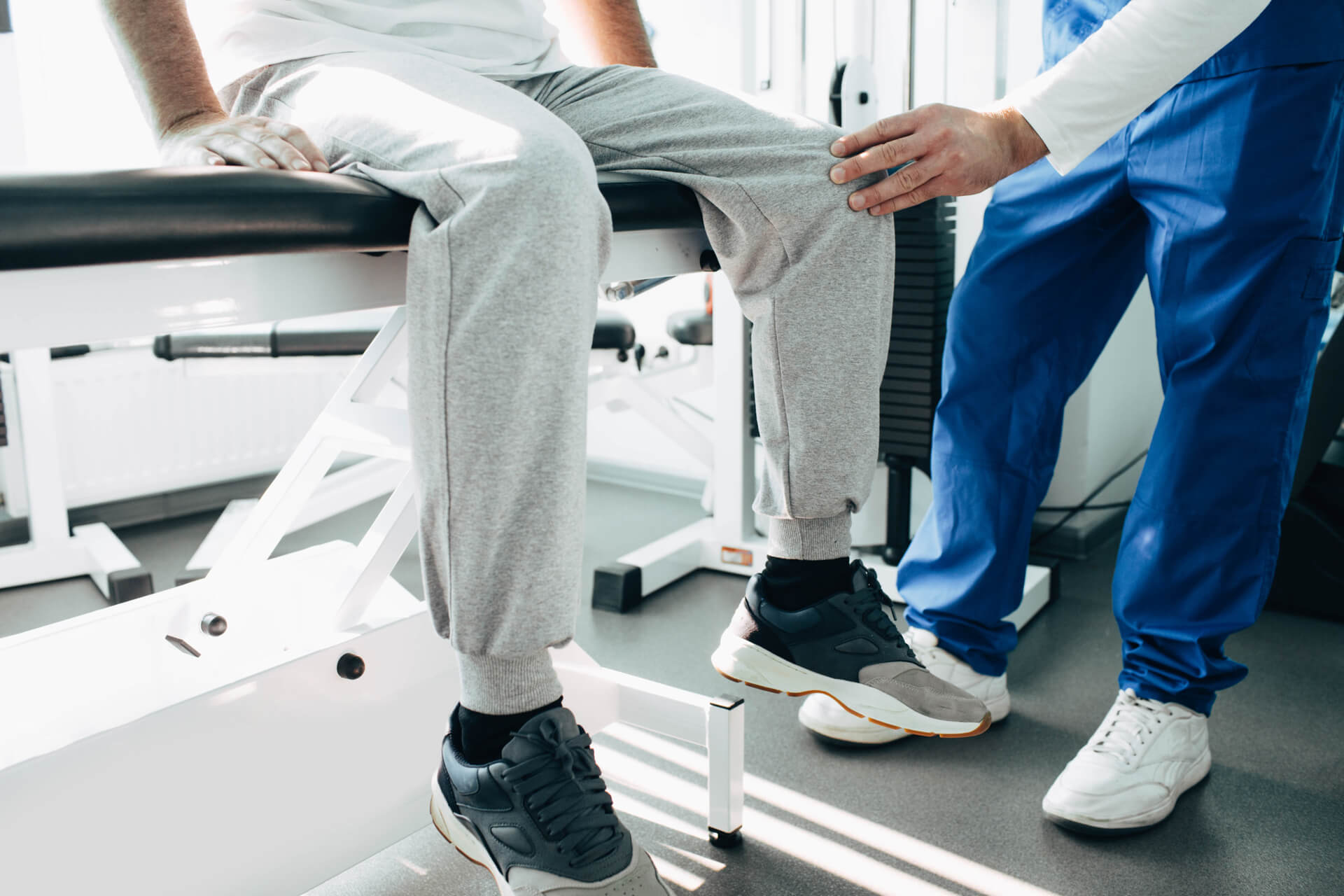
You know physiotherapy has done its job when the pain has settled and the basics are back. But you also know it hasn’t finished the job when you attempt your first run or your first session back in the gym, and the body reminds you that there is still work to do. Post-rehab training exists for exactly that moment. It picks up where clinical treatment leaves off and builds the strength, stability and confidence that physiotherapy was never quite designed to reach. Here are the 10 conditions where it matters most.
Like post-rehab, personal training benefits more than those seeking weight loss. 10 unexpected reasons people hire a PT.
1. Anterior Cruciate Ligament (ACL) Reconstruction Recovery
Tearing the ACL is one of the most common and disruptive sports injuries around, and the road back from reconstruction is longer than most people expect when they’re lying on the operating table. Physiotherapy alone doesn’t restore full pre-injury strength, and re-injury rates stay high in people who return to sport without structured follow-up training. Post-rehab work addresses this by rebuilding quadriceps strength, correcting movement asymmetries and retraining the nervous system to fully activate the repaired leg. For athletes especially, this phase tends to be the deciding factor in whether the comeback holds.
2. Rotator Cuff Injuries and Shoulder Surgery Recovery
The shoulder is one of the most mobile joints in the body, which also makes it one of the least forgiving when the muscles supporting it aren’t doing their job. After a rotator cuff injury or repair, that support system needs to be rebuilt deliberately, not just rested back into existence. Physiotherapy restores the basics well, but the surrounding musculature often still remains weaker, and the postural habits that develop during the protected recovery period stick around. Addressing both at once, post-rehab training rebuilds strength through the full range of shoulder movement and corrects the compensations before they become the next problem. In practice, that looks like targeted work on the posterior shoulder and scapular stabilisers: banded external rotations, face pulls, rear delt flies, and eventually progressive overhead pressing as strength and control return.
3. Chronic Low Back Pain
Here’s something many people with chronic low back pain don’t want to hear: the lower back isn’t always the only place contributing to the problem. Factors such as reduced trunk and hip strength or endurance, movement habits that repeatedly overload the spine, and general deconditioning can all play a role. Physiotherapy helps manage the acute phase and establishes the foundations for recovery, but continuing into a structured strength programme is often what helps create lasting improvements. Post-rehab training builds the trunk and hip capacity needed to better tolerate everyday and sporting loads, which makes it a valuable complement to passive treatment and early rehabilitation.
4. Hip Replacement Recovery
Six weeks post hip replacement, most patients are walking without assistance and feeling cautiously optimistic. What’s harder to see is that the muscles around the new joint, the glutes, hip flexors and surrounding stabilisers, have weakened significantly during the recovery period, and that weakness can affect gait, balance and the long-term health of the implant in ways that compound over time. Post-rehab training progressively strengthens those muscles, improves movement mechanics and restores the functional capacity that makes daily activity feel like daily activity again, rather than something to be planned around. Exercises like glute bridges, clamshells, side-lying hip abductions and progressive single-leg work form the foundation of that process, slowly but steadily rebuilding the hip’s capacity to load and stabilise before more demanding movement is introduced.
5. Total Knee Replacement Recovery
Doing everything right in physiotherapy and still feeling like something is missing at the six-month mark? You’re not alone. Quadriceps weakness, reduced walking endurance and lingering stiffness are consistent complaints among people who followed their rehab closely post-knee replacement and ticked every box. The gap isn’t a sign that something went wrong. Nevertheless, it could be a sign that physiotherapy was never designed to take the recovery all the way. Progressive loading, functional movement work and a programme built around what the person is trying to get back to—this combination is what turns a successful surgery into a true, complete recovery. The knee may be new, but the muscles around it still need to be earned back, and that process takes longer than most surgical timelines account for.
Post-rehab training is a specialism, and finding someone qualified to deliver it is the first step to get it right.
6. Ankle Sprains and Chronic Ankle Instability
Most people who’ve rolled an ankle assume it’s healed once the swelling goes down and the pain goes away. What they don’t realise is that the proprioceptive system, the body’s ability to sense where the joint is in space and react accordingly, often doesn’t recover on its own timeline. Think of it as the ankle forgetting how to trust itself—which is why some say once you’ve twisted your ankle the first time, there will come a second. To counter this, post-rehab training rebuilds that trust through balance work, single-leg stability training and progressive strengthening of the surrounding muscles. Feeling stable on flat ground is not the same as being stable on uneven terrain, and the difference between the two can show up at the worst possible moment. Post-rehab training makes sure the ankle gets tested before life does.
7. Achilles Tendinopathy and Achilles Tendon Repair
The Achilles tendon connects the calf muscles to the heel and is responsible for virtually every push-off movement the foot makes. When it is overloaded repeatedly over time, tendinopathy can develop; when it ruptures, treatment may involve either surgery or a structured non-surgical rehabilitation programme, depending on the injury and the individual. It is slow to adapt and even slower to forgive a rushed return to activity, making it one of those structures that demands to be treated on its own terms. Post-rehab training focuses on progressively loading the tendon, beginning with lower-load exercises (which may include isometric loading) and gradually progressing towards dynamic, higher-impact movement. The goal is to restore the tendon’s capacity to withstand the demands placed upon it. Patience and structure are what this condition rewards, and when both are applied consistently, the improvements are more likely to last.
8. Tennis Elbow (Lateral Epicondylitis)
Despite the name, most people who develop tennis elbow have never been near a court. It’s a condition caused by repetitive overloading of the forearm tendons, and it has a habit of coming back precisely because most treatment stops at the elbow. Physiotherapy manages the pain and introduces the initial loading exercises, and from there post-rehab training takes a more complete view of the problem. Progressive forearm work, grip strengthening and building capacity in the shoulder and upper back should all feature, because improving shoulder and upper back strength can help distribute load more effectively through the upper limb, thus reducing the demands placed on the elbow.
9. Neck Pain Following Whiplash or Cervical Injury
Whiplash is the kind of injury that makes you suddenly, uncomfortably aware of every movement your head makes throughout the day, which is an exhausting way to exist. The acute symptoms settle with physiotherapy, but what tends to linger are weakened deep neck flexors, reduced range of motion and a protective stiffness that the body doesn’t simply switch off even when the pain has gone. Post-rehab training restores cervical strength and endurance, improves postural alignment and gradually reintroduces the neck to controlled loading through progressive upper body work. Most people are surprised by how much capacity comes back when this phase is done at the right pace. It is also one of the few areas of the body that almost nobody trains proactively, which goes a long way towards explaining why cervical injuries take as long as they do to fully resolve.
10. Stroke Recovery and Long-Term Functional Rehabilitation
The early stages of stroke recovery get the most attention, and rightly so. What receives less of it, however, is the period that follows: the months and years when the nervous system is still adapting, physical capacity is still improvable and the right stimulus can still make a meaningful difference. Post-rehab training at this stage focuses on functional strength, balance, coordination and rebuilding the movement patterns affected by neurological changes. Progress is individual, but can take longer than most people expect, and is consistently underestimated by the people going through it. Research shows that physical activity is one of the strongest drivers of recovery after stroke. That said, while the absence of structured training in the post-rehab period is one of the more consequential gaps in long-term care, it is also one that is entirely possible to close with the right support.
From Healing to Performing
Every condition on this list has something in common: physiotherapy addresses the immediate problem, and post-rehab training can help to address what’s left behind. That second phase is where people stop managing their injury and start moving past it, where functional becomes capable, and where the body builds enough resilience to handle whatever comes next without hesitation. That space between functional and fully capable is where we spend most of our time, and in our experience, it’s the most worthwhile place to be. But most people never learn that—and now you have.
At FITLUC, our trainers are experienced across all of the conditions above, with the knowledge and practical background to design programmes that are safe, progressive and built around where each client is. If you’ve recently finished physiotherapy and want structured support for what comes next, get in touch to find out how we can help. With trainers holding qualifications in sport science, strength and conditioning, and corrective exercise, every programme we build is grounded in a thorough understanding of how the body recovers, adapts and performs. That means we start from where your physiotherapy left off—not from the beginning—so nothing is repeated or wasted, and the programme moves forward from day one.
Discover post-rehab training with FITLUC with a no-obligations PT trial.